
Why Urethane Mortar Is the Only Logical Choice for High-Demand Environments
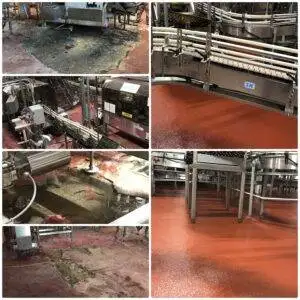
If you manage a food processing plant, brewery, pharmaceutical production facility, or commercial kitchen, your floor is not a background element. It is infrastructure. It takes thermal shock, chemical wash-downs, heavy rolling loads, and biological contamination every single day. Most flooring systems fail under those conditions within two to five years. Urethane mortar does not.
At Maverick Performance Solutions, we install urethane mortar systems because they are the most technically sound option available for facilities where downtime, contamination risk, and maintenance costs are zero-tolerance issues. Here is what you need to know before your next flooring project.
What Makes Urethane Mortar Different
Urethane mortar is a hybrid system: a cementitious aggregate base combined with a polyurethane binder. The result is a floor with compressive strength exceeding 6,000 PSI, tensile strength above 1,500 PSI, and a thermal tolerance range of -40°F to 250°F continuous service temperature. That range matters in freeze-to-oven transitions that crack epoxy systems within a single production cycle.
Key technical properties that separate urethane mortar from alternatives:
- Thermal shock resistance: Withstands rapid temperature changes of 100°F or more without delamination or cracking — critical for steam cleaning protocols and CIP (clean-in-place) systems.
- Chemical resistance: Resists lactic acid, phosphoric acid, caustic soda, and most cleaning agents used in food/beverage production at concentrations up to 30%.
- Moisture tolerance: Can be installed over green concrete with relative humidity up to 99% RH — eliminating the moisture mitigation delays that stall epoxy installations.
- Slip resistance: Broadcast aggregate finishes achieve DCOF values above 0.42 wet, meeting ANSI A137.1 standards for wet commercial environments.
- Thickness: Standard installations run 3/16″ to 1/4″ (approximately 188–250 mils), providing a substantial wear layer compared to thin-film epoxy coatings at 20–40 mils.
Compliance and Standards You Must Meet
Facility managers in regulated industries cannot afford a flooring contractor that is vague about compliance. Urethane mortar systems, when properly specified and installed, meet or support compliance with:
- FDA 21 CFR Part 110 / FSMA: Flooring must be smooth, durable, cleanable, and impervious to moisture in areas where food is processed or stored.
- USDA AMS guidelines: Require non-porous, easily sanitized surfaces in food contact zones.
- OSHA 1910.22: Walking-working surfaces must be clean, dry where possible, and slip-resistant where wet.
- GMP (Good Manufacturing Practice) environments: Seamless, coved flooring systems eliminate harborage points for bacteria and pathogens.
- NSF/ANSI 51: Relevant for food equipment surface materials — select urethane mortar products are NSF-listed for direct contact zones.
Pharmaceutical facilities operating under USP <797> or ISO cleanroom classifications require additional considerations around particle generation and chemical resistance. Urethane mortar with a sealed topcoat satisfies both surface hardness and low-emission requirements.
Installation Realities: What Separates Good from Great
The chemistry is only half the equation. Urethane mortar installation demands precise surface preparation and application sequencing. Every Maverick installation begins with ICRI CSP 3–5 surface profile preparation — typically achieved through shot blasting — to ensure mechanical bond. We test substrate moisture using ASTM F2170 (in-situ probe) and ASTM F1869 (calcium chloride) to document baseline conditions before any material touches the floor.
Coving and Radius Work
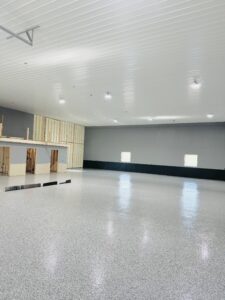
One of the most overlooked details in food/beverage environments is the floor-to-wall cove. Flat 90-degree transitions are a cleaning failure point and a FDA inspection target. Maverick installs 4″ radius coved bases as standard practice on all food/pharma projects, creating a continuous, seamless transition from floor to wall that eliminates harborage points and supports wash-down protocols.
Drainage Integration
Sloped-to-drain systems require precise layout geometry. We achieve consistent 1/8″ per foot slope tolerances to ensure water exits the floor completely — stagnant water is a contamination risk and a slip hazard. Trench drain integration uses compatible urethane mortar transition materials to prevent the edge cracking that destroys otherwise solid installations.
Lifecycle Cost: The Argument That Closes the Discussion
A thin-film epoxy system installed for $3–5/SF will begin showing wear, micro-cracking, and chemical staining within 18–36 months in a high-demand food environment. Replacement costs, facility downtime, and sanitation failures compound over a 10-year ownership period. Urethane mortar installed correctly at $8–14/SF holds its performance characteristics for 15–20 years with only surface maintenance. The math is not close.
Ready to Specify the Right System?
Maverick Performance Solutions works directly with facility managers, plant engineers, architects, and GCs across the industrial and commercial sectors. We provide pre-bid specification support, substrate assessments, and detailed installation proposals with documented compliance pathways.
Contact Maverick today to schedule a site assessment or discuss system specifications for your next project.