Warehouse Floors Take More Abuse Than Any Other Surface in Your Facility
A warehouse or distribution center floor handles daily punishment that would destroy most building materials in months: loaded forklifts running 16-24 hours per day, pallet jacks grinding across joints, racking legs concentrating tens of thousands of pounds onto small base plates, battery charging areas exposed to sulfuric acid, and dock doors cycling between interior conditions and exterior weather.
The wrong flooring system — or no flooring system at all — results in deteriorating joints, dusting concrete, safety hazards, and increasing maintenance costs that compound every year. The right system, correctly specified and installed, provides a maintenance-free surface for 10-15 years.
Traffic Analysis: Understanding Your Load Profile
Before specifying a flooring system for a warehouse, you need to understand the actual loads the floor will carry:
Forklift Traffic
- Counterbalance forklifts (5,000-10,000 lb capacity): Total loaded weight 12,000-22,000 lbs. Steer tire contact area ~20 sq in. = 600-1,100 PSI contact pressure. Polyurethane tires are standard — less aggressive than pneumatic but still create significant surface wear.
- Reach trucks and order pickers: Lower contact pressure but higher travel speeds in narrow aisles. Surface flatness (FF/FL numbers) matters for stability at speed.
- Pallet jacks: Small steel or polyurethane wheels concentrate load on narrow contact patches. Joint crossings create repetitive impact that spalls unprotected concrete edges.
Racking Point Loads
Selective pallet racking legs typically carry 5,000-15,000 lbs per upright. Base plates (typically 4″ x 8″ or 5″ x 10″) create contact pressures of 150-375 PSI — well within concrete and coating tolerances. However, the repetitive loading cycle from forklift impacts against rack legs creates dynamic loads that can crack thin-film coatings around base plates.
Recommended Systems by Zone
General Traffic Aisles
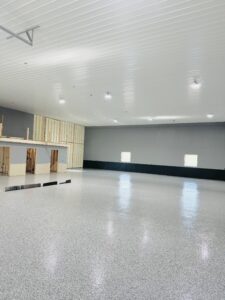
Broadcast epoxy system: 100% solids epoxy body coat at 15-20 mils DFT with full broadcast #20-40 mesh quartz aggregate and sealed with polyaspartic or urethane topcoat at 6-10 mils DFT. Total system thickness: 30-50 mils. This system handles forklift traffic, resists chemical spills, and provides a cleanable, light-reflective surface.
Battery Charging Areas
Novolac or vinyl ester system: Battery charging areas are exposed to sulfuric acid from battery maintenance and electrolyte spills. Standard epoxy cannot resist sulfuric acid at any concentration. Novolac-modified epoxy or vinyl ester systems provide verified acid resistance. Containment curbs and sloped-to-drain construction are typically required by local code.
Dock and Loading Areas
Heavy-duty urethane or polyurea: Dock areas experience thermal shock from open doors, impact from dropped loads, and moisture intrusion. Flexible urethane or polyurea systems accommodate thermal movement while providing impact resistance. Slip-resistant aggregate broadcast is mandatory for wet dock areas.
Cold Storage
MMA (methyl methacrylate) or urethane mortar: Cold storage environments require coatings that cure at low temperatures and maintain flexibility at sub-zero conditions. MMA systems cure as low as -20°F. Urethane mortar handles continuous service at -40°F without cracking or delamination.
Joint Protection: The Most Overlooked Detail
Control joints in warehouse floors are the number one maintenance issue. Forklift wheels cross joints thousands of times per day, creating impact loading that spalls unprotected edges. Within 2-3 years, unprotected joints deteriorate from clean-cut saw lines to ragged, crumbling channels that damage equipment, create tripping hazards, and generate concrete dust that contaminates inventory.
Semi-rigid epoxy joint fillers (like our MavJoint 860JF) fill the joint to surface level and absorb impact without cracking. Joint filling before coating application is standard practice on every Maverick warehouse project.
Build the Floor Your Operation Demands
Warehouse flooring is not a cosmetic upgrade. It is operational infrastructure that directly affects productivity, safety, maintenance cost, and facility value. Specify it correctly the first time, and it works silently in the background for a decade. Specify it wrong, and it demands attention — and budget — every year.
Contact Maverick Performance Solutions to discuss flooring specifications for your warehouse or distribution facility.